
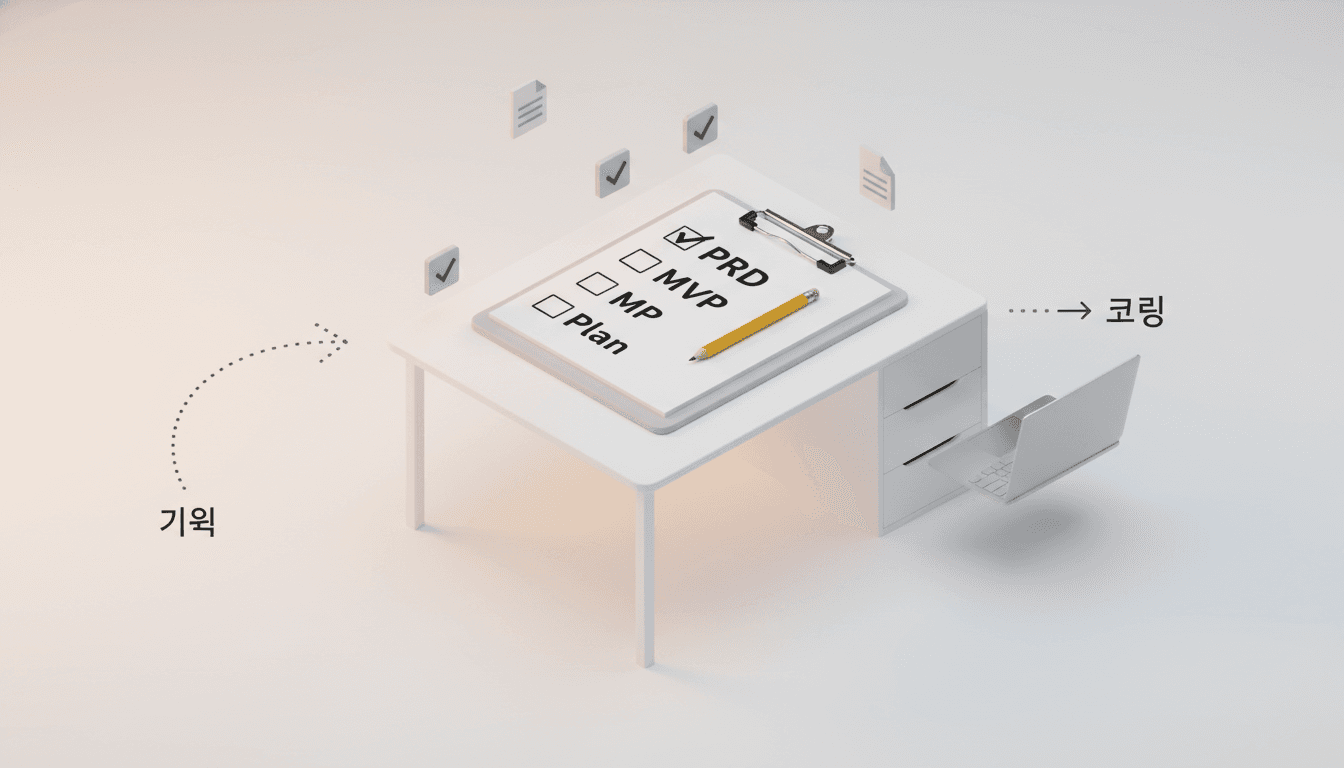
The Real Trap of Vibe Coding - It's Not About Coding, It's About Planning
Why your AI coding projects fail: Learn why proper planning and PRD creation are more important than coding skills in vibe coding success.
Why Does AI-Generated Code Always Turn Into a Mess?
Cursor, Claude Code, GitHub Copilot… AI coding tools are popping up everywhere these days. You got excited hearing "now anyone can build services without coding," but when you actually tried it, the results were a disaster. Sound familiar?
When you say "GPT, build me an e-commerce site," it enthusiastically generates code. But as you use it, weird issues start appearing one by one. Pages exist but aren't connected, shopping cart works but checkout doesn't, users can sign up but can't log in...
The problem isn't AI's coding ability. The problem is that neither the AI nor even you know exactly what you want to build.
Most people jump straight to "build this for me," but good code starts with good planning. Today, we'll reveal the real reason why vibe coding fails and demonstrate the importance of MVP spec setting and feature prioritization.
Feasibility Check: Think From 3 Perspectives First

Before you start coding, you need to check if your idea is actually feasible from three perspectives.
1. Technical Perspective: Does the Technology Actually Make Sense?
Some people request "build me a free AI chatbot that runs locally." Sounds plausible, but reality is different.
- Running local LLM requires minimum 16GB+ RAM
- Without GPU, response speed is too slow for practical use
- Model files alone are tens of GBs, making deployment difficult
Solution: For MVP stage, it's realistic to first use cloud services like OpenAI API or Claude API, then create a roadmap to transition to local models later.
2. Legal Perspective: Are There Any Legal Issues?
You can say "build me a crypto auction platform" and code can be generated. But what about legally?
- Virtual asset trading is regulated by specific financial information laws
- Auction systems are subject to multiple laws including e-commerce and consumer protection
- Consent procedures for personal information collection and use are required
Solution: For services requiring legal review, a phased approach is safer—first implement simulation mode in MVP, then add actual transaction features after legal consultation.
3. Market Perspective: Can You Prepare Both Sides in MVP?
"Build me a ride-sharing platform like Uber" is a classic failure case. Platform businesses require both suppliers and consumers to function, but securing both simultaneously in MVP stage is nearly impossible.
Solution: Realistically, focus on one side initially. For example, build only the driver app first with manual dispatching by admin, or use mock vehicle data in the passenger app to validate UI/UX first.
MVP vs MMP vs MAP - What Should You Build First?

Many people know the term MVP (Minimum Viable Product), but get confused about how far to build. Let's clearly distinguish these three concepts.
MVP (Minimum Viable Product) - Minimally Functioning Product
Only the most basic features implemented. Just at the "it technically works" level.
E-commerce Example:
- View product list
- Add to cart
- Place order (only saves order info without actual payment)
While technically functional, this is too embarrassing to show actual users.
MMP (Minimum Marketable Product) - Minimally Promotable Product
One step beyond MVP, at a level where "you can show it off to people." Since MVP alone is often too embarrassing to promote, we recommend meeting MMP standards in practice.
E-commerce Example (MVP + additions):
- Actual payment integration (PG integration)
- Order history view
- Basic admin page
- Product search functionality
- Mobile responsive design
At this level, you can promote on SNS saying "we built this service."
MAP (Minimum Lovable Product) - Product Users Can Love
Beyond just working, at a level where users feel "this is nice!"
E-commerce Example (MMP + additions):
- Personalized product recommendations
- Wishlist functionality
- Review and rating system
- Coupon/discount system
- Order notifications (email, SMS)
Realistic Advice: When starting out, aim for MMP. MVP has too few features for meaningful feedback, and MAP is too burdensome for initial stages.
Phased Validation Plan: Do the Hard Stuff Later

The key is to substitute difficult features rather than attempting them from the start. Let's look at an actual project case.
Case Study: AI Document Summary Service
Original Idea:
- Support all document formats (PDF, Word, PPT, Excel, etc.)
- Free operation with local LLM
- Real-time streaming responses
Realistic MVP Phase:
- Document Format: All formats → Limited to Markdown (.md)
- Reason: PDF parsing is complex and error-prone. Markdown is text file, easy to process
- LLM: Local LLM → Substitute with OpenAI API
- Reason: Local operation has infrastructure burden. API is immediately usable
- Response Method: Real-time streaming → Batch response
- Reason: Streaming adds complexity to both frontend and backend
MMP Phase Additions:
- PDF support (prioritize most demanded format)
- Implement streaming responses (improve user experience)
MAP Phase Additions:
- Support additional formats like Word, PPT
- Provide local LLM option (for power users wanting cost savings)
Core Principles
-
Replace technically difficult things with proven solutions
- Direct implementation < Library/API utilization
-
Start narrow for broad scope
- Support all formats < Just the most important one
-
Simplify complex UX
- Real-time streaming < Batch response
- Drag and drop < Button click
When you divide phases like this, AI coding tools can generate clear code without confusion.
Complete PRD in 10 Minutes with Vooster AI
If you've read this far, you're probably thinking "so how am I supposed to organize all this?" This is where Vooster AI comes in.
Vooster AI's Product Manager AI systematically guides you through questions like:
- What problem does your service solve?
- Are there similar services? How is yours different?
- Who are your expected users?
- If you had to pick just 3 core features?
- What features can be excluded from MVP?
As you answer these questions, a PRD (Product Requirement Document) naturally gets completed. And based on this PRD:
- Automatic Task Generation: Breaks down PRD into development phase tasks
- Priority Setting: Distinguishes what to do first vs later
- MCP Integration: Directly integrates with Cursor, Claude Code for task checking during coding
Success Formula for Vibe Coding:
Good Planning (PRD) → Clear Tasks → AI Coding Tools → Successful Results
No matter how good your AI coding tool is, bad planning leads to messy results. Conversely, with a clear PRD, AI will build exactly what you want.
Conclusion: 10 Minutes of Planning Before Vibe Coding Saves Dozens of Hours
Vibe coding doesn't fail because AI lacks capability. It fails because you start without clarity on what to build.
Before starting to code, check these:
- Feasibility Assessment: Is it realistic from technical/legal/market perspectives?
- MVP Scope Setting: Are you planning to build to MMP level?
- Phased Roadmap: Hard features later, simple alternatives first?
Just organizing these three things completely changes your AI coding tool's output.
Before starting vibe coding, invest just 10 minutes in planning with Vooster AI. One PRD prevents dozens of hours of struggling.
Start your systematic vibe coding journey with Vooster AI today!
Start Structured Vibe Coding with Vooster
From PRD generation to technical design and task creation - AI helps you every step. Start free today.
PRD Generation
Auto-generate detailed requirements
Technical Design
Implementation plan & architecture
Task Generation
Auto-break down & manage dev tasks
No credit card required · Full access to all features
Related Posts
What is Vibe Coding? The Future of AI-Powered Development in 2025
Discover vibe coding: the revolutionary AI-powered development approach. Learn 3 essential rules, real success stories, and how to build better products faster.
How to Prevent AI from Over-Engineering Your MVP
Learn how to prevent AI from adding unnecessary features like caching, audit logs, and performance optimizations to your MVP projects.

5 Advanced Vibe Coding Tips Every Developer Should Know
Master AI-powered development with these 5 essential vibe coding techniques. Learn how to write better plans, optimize context usage, and maximize AI potential.